
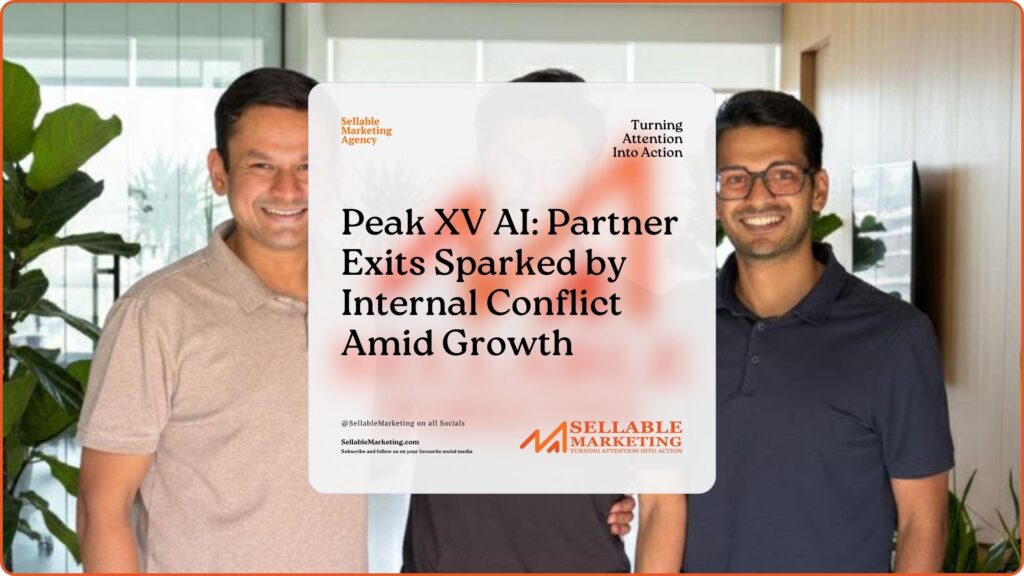
Peak XV AI has entered a period of internal upheaval following the exit of key partners, an episode that underscores the governance challenges facing fast-growing technology firms operating at the intersection of capital, talent, and strategic control. Partner departures reportedly stem from internal conflict rather than market contraction, suggesting structural and cultural tensions emerging alongside expansion.
Rapid growth often masks unresolved governance weaknesses. As AI firms scale, decision-making authority, equity alignment, and long-term vision become increasingly contested. Partner exits in such contexts rarely occur in isolation. They often reflect deeper disagreements over strategy, risk tolerance, or the distribution of influence within leadership structures.
Internal Conflict As A Growth Stress Test
Growth introduces complexity. Capital inflows, rising valuations, and heightened public visibility intensify pressure on internal systems that may have been sufficient earlier. Disputes among partners frequently center on control over product direction, client prioritization, or monetization strategies, particularly when timelines for profitability diverge.
Organizational research consistently shows that leadership misalignment during scaling phases increases the likelihood of executive turnover. Partner exits can signal unresolved power struggles rather than personal career decisions, raising questions about how governance frameworks evolve as businesses expand.
Partner departures carry operational consequences. Loss of institutional knowledge, disruption of client relationships, and uncertainty among staff often follow leadership exits. In AI-focused firms, where expertise and continuity play a critical role in product development and trust, instability at the top can slow execution and erode confidence.
Investors and enterprise clients increasingly scrutinize governance resilience as part of risk assessment. Internal conflicts that lead to public exits may raise concerns about strategic consistency, particularly in sectors where long-term data partnerships and regulatory compliance demand stable leadership.
Limited transparency around internal disputes complicates external assessment. Without clear communication, narratives often emerge through speculation, potentially amplifying reputational risk. Effective governance requires not only dispute resolution mechanisms but also credible communication strategies that reassure stakeholders without exposing sensitive internal dynamics.
Corporate governance best practices emphasize clarity in partner roles, dispute resolution pathways, and succession planning. Absence of such structures tends to surface during periods of rapid growth, when informal arrangements no longer suffice.
Broader Lessons For AI Sector Leadership
Peak XV AI situation reflects a broader pattern across the AI sector. Startups transitioning into scale-ups frequently struggle to reconcile founder-driven cultures with institutional governance demands. Partner exits serve as cautionary signals that growth without governance maturity can destabilize even well-positioned firms.
Long-term competitiveness in AI markets depends as much on internal coherence as on technical innovation. Firms that fail to address governance tensions early risk repeated cycles of disruption that divert attention from product development and market execution.
Strategic Outlook
Partner exits do not inherently signal decline. Outcomes depend on how leadership responds. Transparent restructuring, reinforced governance frameworks, and clear strategic articulation can stabilize organizations post-departure. Failure to act decisively, however, risks prolonging uncertainty and undermining stakeholder trust.
Growth remains an opportunity only when supported by durable internal alignment. For AI firms navigating rapid expansion, governance resilience increasingly defines sustainable success.
Key Takeaways
- Partner exits at Peak XV AI appear linked to internal conflict rather than market conditions.
- Rapid growth often exposes weaknesses in governance and leadership alignment.
- Leadership turnover can disrupt operations, client trust, and employee confidence.
- Transparency and dispute resolution frameworks are critical during scaling phases.
- AI sector firms face heightened scrutiny of governance alongside innovation.
- Sustainable growth depends on aligning expansion with institutional maturity.