The Best SEO Tools for Marketing in 2026: What Actually Works
We built and ran the research platform described in this article. All Nigerian search figures below were measured on 9 September 2026 using live data from Sellable Workspace.
Key points
SEO tools for marketing do six jobs: find demand, cluster it into pages, expose competitor gaps, audit technical health, brief and optimise content, and measure AI visibility.
Sellable Workspace is a pay-as-you-go SEO research platform. You buy credits rather than a monthly seat; the credits never expire, and a month in which you run nothing costs nothing.
AI visibility is the newest of the six jobs. Most major platforms now sell it as a paid add-on or a higher tier. Sellable Workspace includes it in the same workspace as your keyword data.
Sellable is building its own backlink index. If link analysis drives your work, expect it in your workspace soon.
The job no major platform covers is turning a finding into assigned work. Research is cheap. Programmes stall because insight never reaches a person with a deadline.
Introduction
You have probably got a browser tab open right now with a free keyword tool in it. Most marketers do. You typed in a term, it returned "100 to 1K searches per month", and now you are trying to work out whether that means it is worth a page or worth ignoring.
That gap is the whole problem. Not the price of tools. The resolution of what they tell you.
Marketing runs on decisions. Which page to write next. Which service to build content around. Whether the term your homepage has been built on for three years has anyone searching it at all. Each of those decisions costs real time and money to act on. Each of them gets made badly when the number underneath is a bracket instead of a figure.
This piece walks through the SEO tools for marketing that earn their place in 2026, organised by the job each one does rather than by brand. You will get an honest comparison of the main platforms, including where ours is the wrong choice. You will also get a clear view of the one job most stacks skip entirely, which is turning a finding into something a person actually does on Monday morning.
No affiliate links. No sponsored placements. Just the shape of a stack that works.
The guess that cost eighteen months
A law firm in Wuse II hired a consultant three years ago to handle its SEO. She was good at her job. She built a content strategy, wrote four service pages, and promised page one within six months.
Eighteen months later, they sat on page three. The consultant had moved on. The firm had spent a considerable sum and had nothing ranking.
Nobody had measured the demand first. The strategy was built on terms that sounded right rather than terms with volume behind them. Every page was well written and pointed at nothing.
When they finally ran the numbers, "law firm in abuja" returned 880 searches per month with a difficulty of 15, as of 11 September 2026. Entirely winnable. It had been winnable the whole time. Nobody had looked.
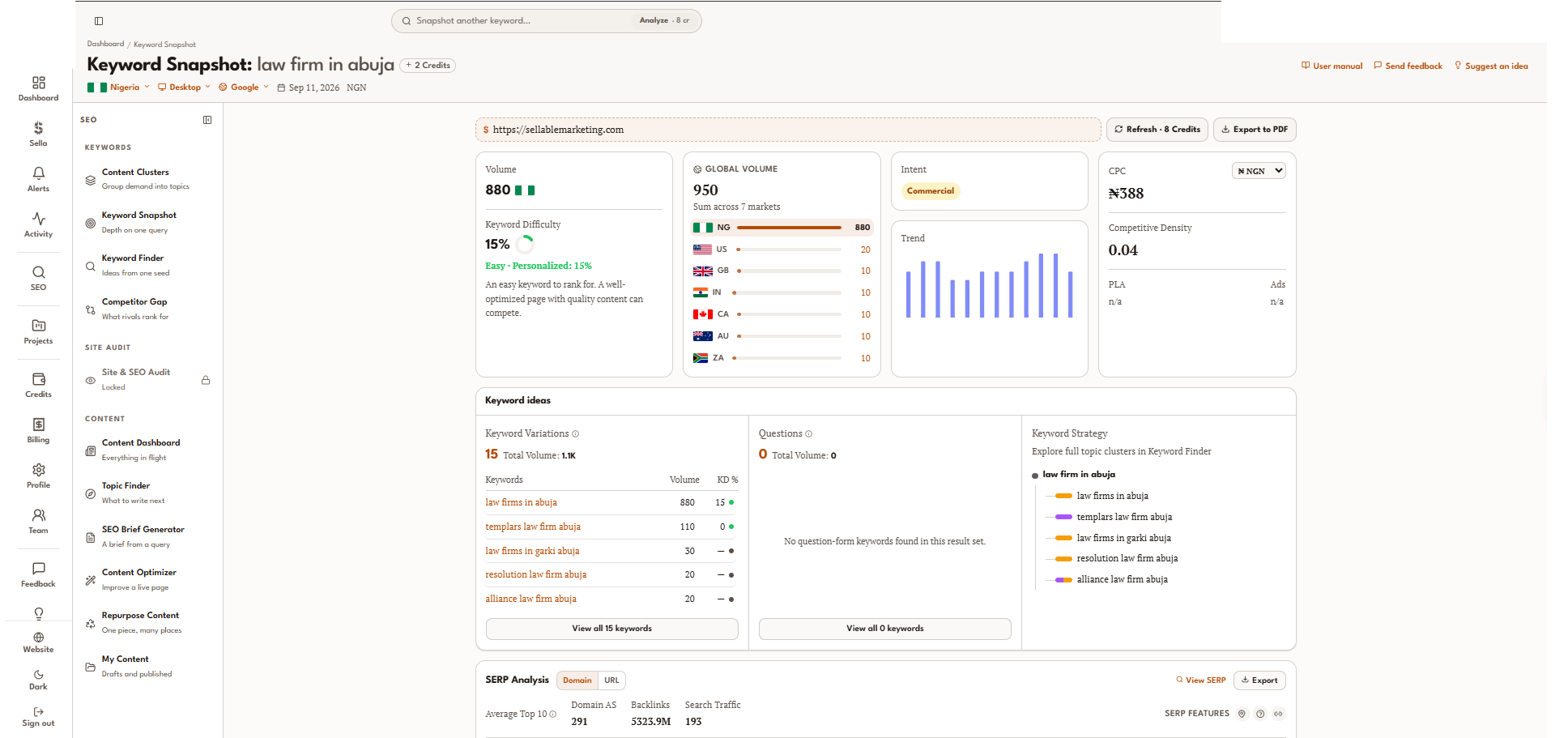
That is not a story about a bad consultant. It is a story about the tools she could reach. Professional research platforms are priced in dollars on monthly subscriptions, so plenty of capable people work on instinct instead. The strategy is sound. The numbers underneath it were never measured.
What does an SEO tool for marketing actually need to do?
Ignore the dashboards and the feature lists. Underneath, every SEO tool is doing some combination of six jobs. What separates them is which jobs they cover and how many you end up paying for twice.
The six run in a natural order. Find the demand first. Group it into pages worth writing. Work out what your rivals rank for that you do not. Confirm your site can technically rank at all. Write the page, then improve it once it is live. Finally, find out whether AI assistants mention you when someone asks for a recommendation in your category.
Most platforms do three or four of these well and pad the rest. Here is what each job actually needs.
1. Find the demand
This is the foundation, and it is where free tools fail hardest.
You need two things from this stage. Breadth, so one seed term returns hundreds of real queries rather than a dozen. And depth, so a single query gives you volume, difficulty, cost per click, intent, and twelve months of history.
Sellable is a pay-as-you-go SEO research platform built by Sellable Marketing Agency, a digital growth agency operating across the UK, United States, Europe and Nigeria. It covers keyword research, competitor gap analysis, technical auditing, content optimisation and AI visibility tracking in one workspace, priced in credits rather than a monthly subscription.
Those two jobs sit in separate tools on purpose. Keyword Finder takes one seed and returns up to 1,000 real queries with live metrics attached. Keyword Snapshot takes a single query and goes deep on it. You use Finder to map a market and Snapshot to decide whether one term deserves a page.
Ahrefs and SEMrush both handle this stage well. Free tiers do not, because they return brackets and cap you at a handful of lookups a day. That is fine for validating one keyword. It is useless for mapping a market.
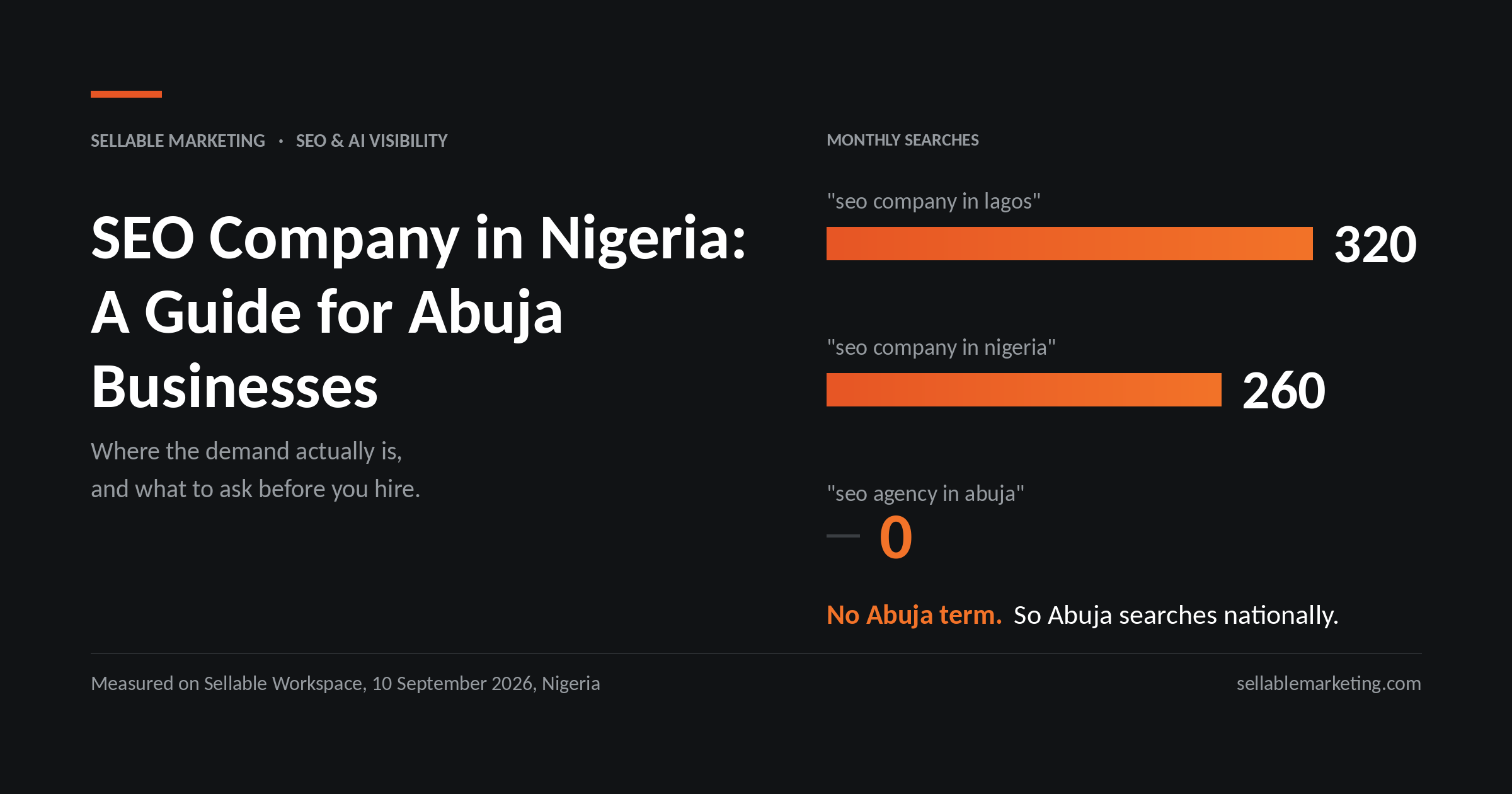
Resolution matters more than it sounds. Measured on 9 September 2026, "seo tools for marketing" runs at 720 searches a month in Nigeria at a difficulty of 7, and it held 880 a month for six consecutive months earlier in the year. "seo tools" on its own runs at 590 a month at a difficulty of 72. Same subject. One winnable, one not. A bracketed free tool returns the same label for both.
Takeaway: if your tool returns a range rather than a number, you cannot tell a dead term from a quarter of work.
2. Turn demand into a content plan
A thousand keywords are not a plan. It is a spreadsheet nobody opens.
The job here is clustering: grouping queries that share intent, so one strong page serves twenty terms instead of twenty thin pages competing with each other.
Content Clusters does the grouping. Topic Finder answers what comes next. Between them, you go from a raw keyword list to an ordered queue.
Most marketers skip this step entirely. They export the list, pick the five terms with the highest volume, and write five pages. Then they wonder why none of them rank. Volume is not opportunity, and five unrelated pages build no topical authority at all.
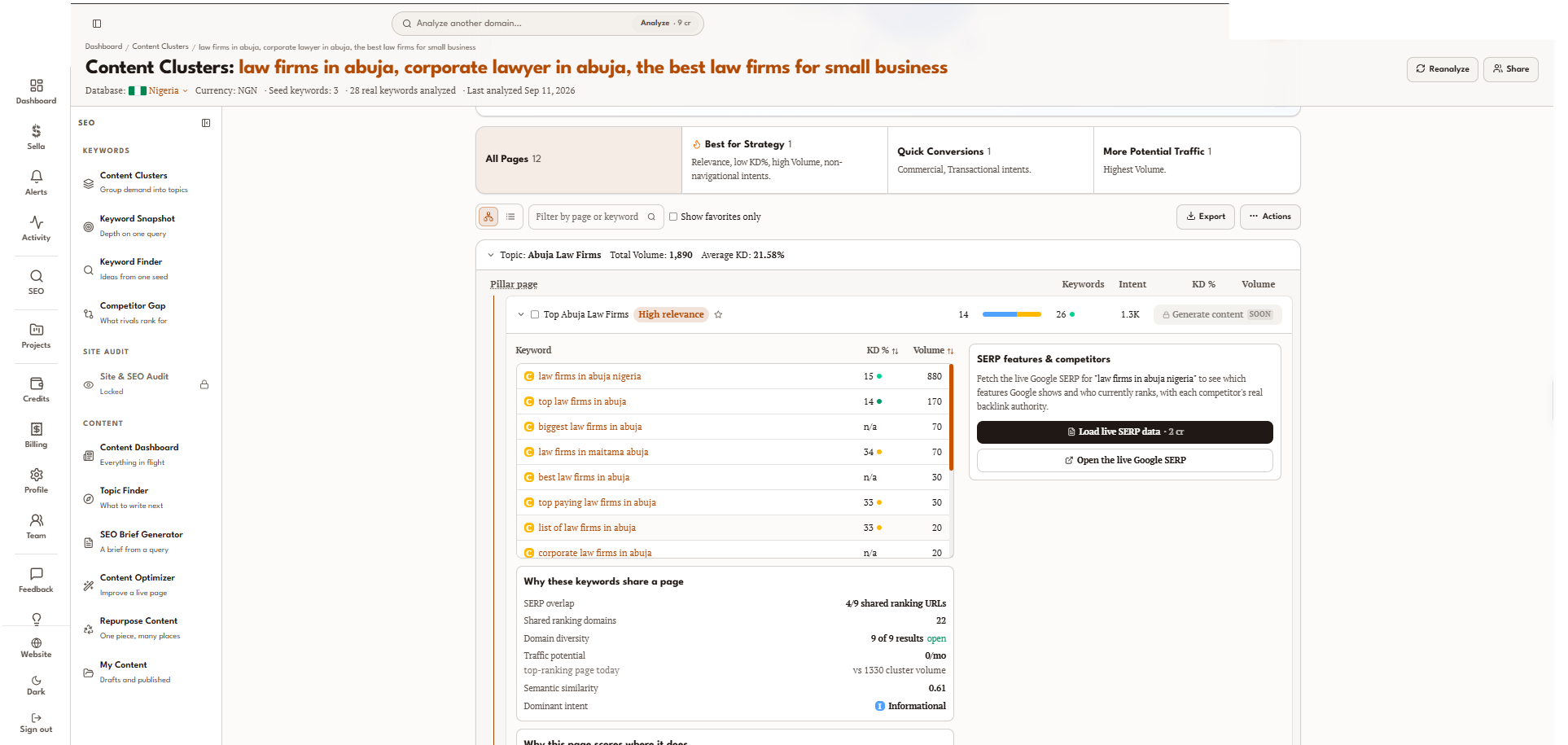
Takeaway: clustering is the difference between a keyword list and a content strategy.
3. Find the gap your rivals are filling
Your competitors have already done research that you have not. Competitor Gap shows what up to three rivals rank for that you have nothing on, across organic, paid, and Shopping.
When you are starting cold, this is the fastest route to a plan. You are not guessing what the market wants. You are looking at what already works for someone else and finding the pages you never built.
A group of businesspeople in Maitama used exactly this to move into Lagos and Port Harcourt without opening offices in either city. The gap analysis surfaced nine pages that their Lagos rivals ranked for. They have written six so far and now hold page one for two Port Harcourt terms, from a Maitama office.
Takeaway: competitor gap analysis turns your rivals' research budget into your content plan.
4. Can your site technically rank at all?
You can have the best content plan in Abuja, Nigeria, and still lose to a slow site with broken canonicals.
Site & SEO Audit crawls the domain and reports technical health: what is indexable, what is broken, what is slow, and what is quietly blocking the pages you already published. Run it before the content work, not after. There is no sense in publishing twenty pages onto a domain with an indexing problem, and it is far cheaper to find that out first.
Auditing inside the same workspace as your keyword data changes what you do with the results. A standalone crawler hands you a spreadsheet of errors with no view of which pages matter commercially. On Sellable, the audit sits beside the demand data, so you can see that the page with the canonical problem is the one targeting your highest-value term. Fix that first. The rest can wait.
Findings then go straight into Projects and Tasks with an assignee and a date, rather than sitting in an export nobody opens.
Takeaway: audit first, then prioritise by commercial value rather than by error count.
5. Can you write, improve, and publish in one place?
Four tools cover this stage, and the last one is the reason the other three matter.
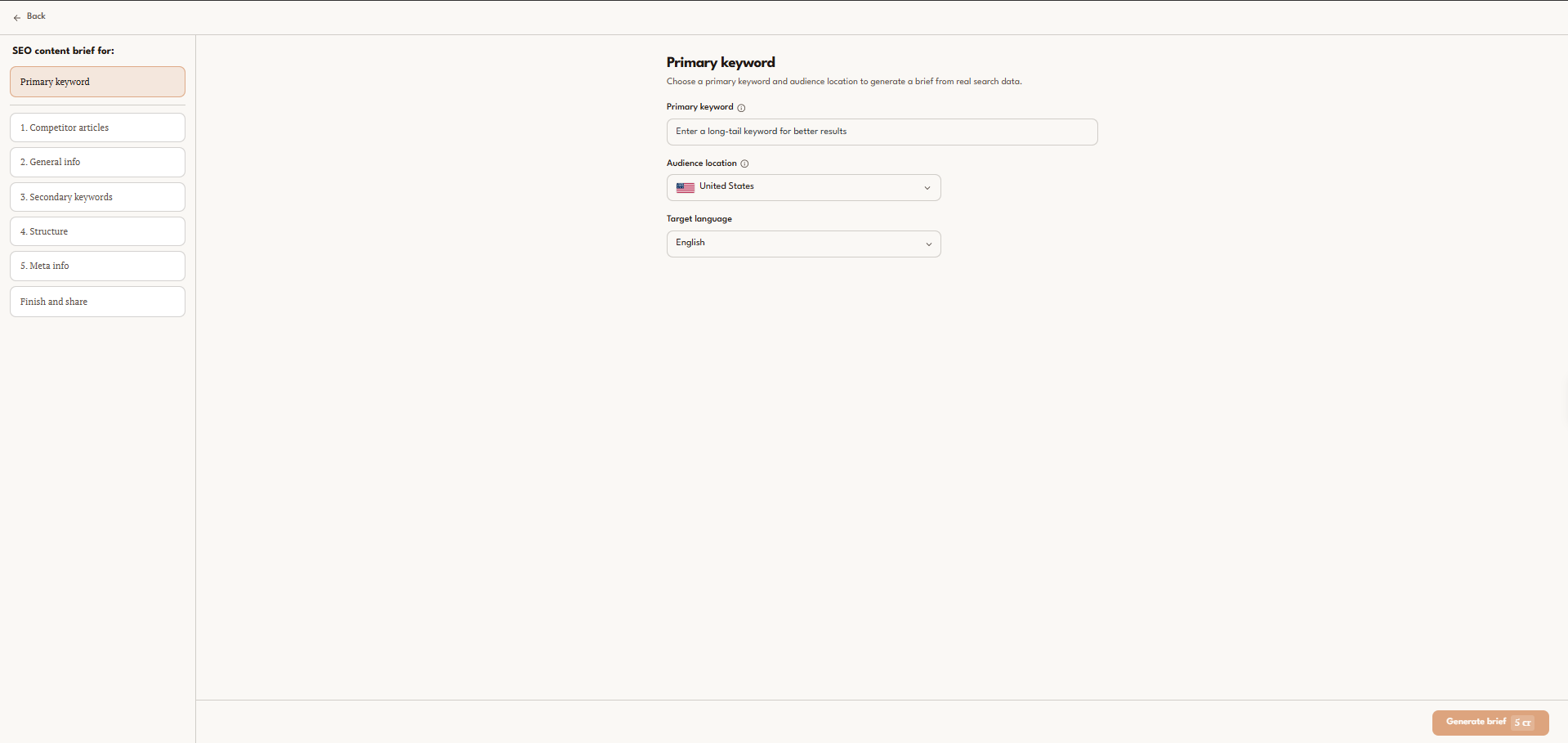
SEO Brief Generator turns a query into a brief, so whoever writes the piece knows the target term, the secondary terms, and the angle before they start. Content Optimiser works on pages already live, which matters because lifting a page from position 12 to position 4 is nearly always cheaper than writing a new one. Repurpose Content takes one piece and reshapes it for other channels. My Content holds drafts and published pieces in a single view, so you can see what is in flight rather than guessing.
Then you connect your website to the workspace and publish straight from it.
On Sellable Workspace, the research, the brief, the draft, the optimisation, and the published page are one continuous piece of work. You measure a term, write against it, score the draft, publish it, and watch that same term move. Nothing gets retyped. Nothing gets lost between systems.
Takeaway: update high-performing pages before writing new ones. It is the highest return work in content marketing, and it only actually happens when improving a page and republishing it are the same action.
6. What do AI assistants say about you?
This job is new, and most stacks do not cover it at all.
It is worth separating two things that are sold under the same label. Most AI SEO tools generate copy: they write the draft, suggest the headline, and fill the meta description. Useful, and increasingly a commodity. The category of AI SEO tools that actually changes decisions does something different. It measures what the assistants say about you.
When someone asks ChatGPT, Claude, Gemini, Perplexity, or Copilot to recommend a firm in your industry, the answer arrives as prose. No positions. No ten blue links. You are either named in the sentence, or the answer is about somebody else.
AI Visibility measures which prompts in your industry the assistants answer, and whether you appear in them. That traffic does not show up as organic search in your analytics, so unless you measure it deliberately, you have no idea whether you are winning or invisible.
Most major platforms now treat this as a paid add-on or reserve it for a higher tier. In Sellable, it runs in the same workspace as the keyword data, which matters because the two are the same underlying work measured in two different places.
Takeaway: search now has two front doors. Optimise for one, and you are guessing about the other.
Which SEO tool is best for marketing teams?
The table below compares Sellable, SEMrush, Ahrefs, and Ubersuggest across billing model, core research features, AI visibility tracking, and free entry. Compiled 9 September 2026. Pricing and packaging change often, so confirm current terms with each provider before committing.
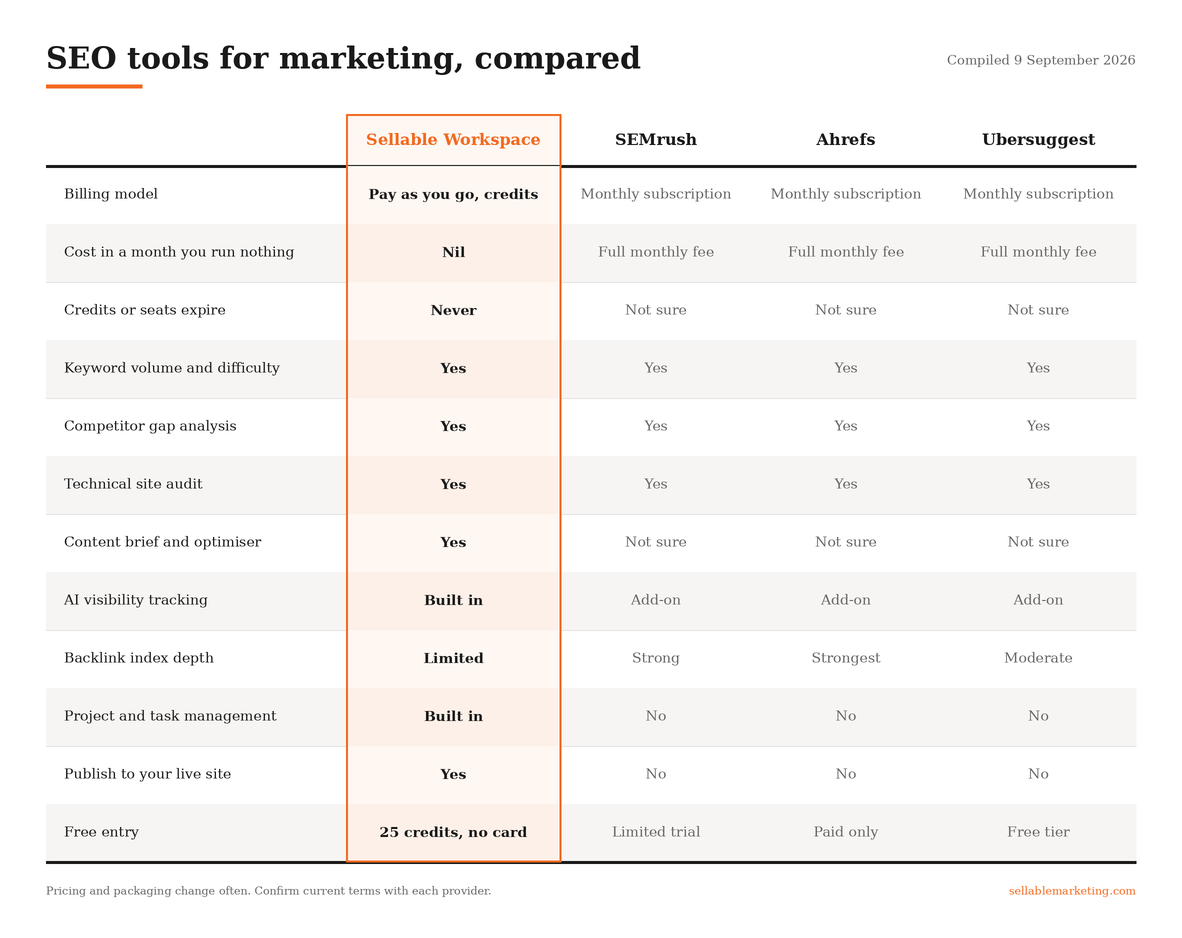
Two honest notes on that table.
If backlink analysis is central to how you work, Ahrefs holds the deepest index, and you should buy it. We do not pretend otherwise.
The pay-as-you-go model earns its place on a different axis, which is the shape of your cash flow rather than the depth of any single feature. This is where SEO tools for agencies diverge sharply from tools built for in-house teams on a fixed budget. Agency work is lumpy. Two strong months, a quiet one, then a sprint to deliver. A subscription charges you the most during the stretch when nothing has come in. Credits reverse that. Run six scans the week you land a retainer, run nothing in February, and February costs nothing.
The same logic applies to SEO tools for small businesses running their own marketing. One owner researching their own market a few times a year should not carry twelve monthly payments to do it.
The job nobody's tool stack does
Here is the gap in every platform on that table, including the expensive ones.
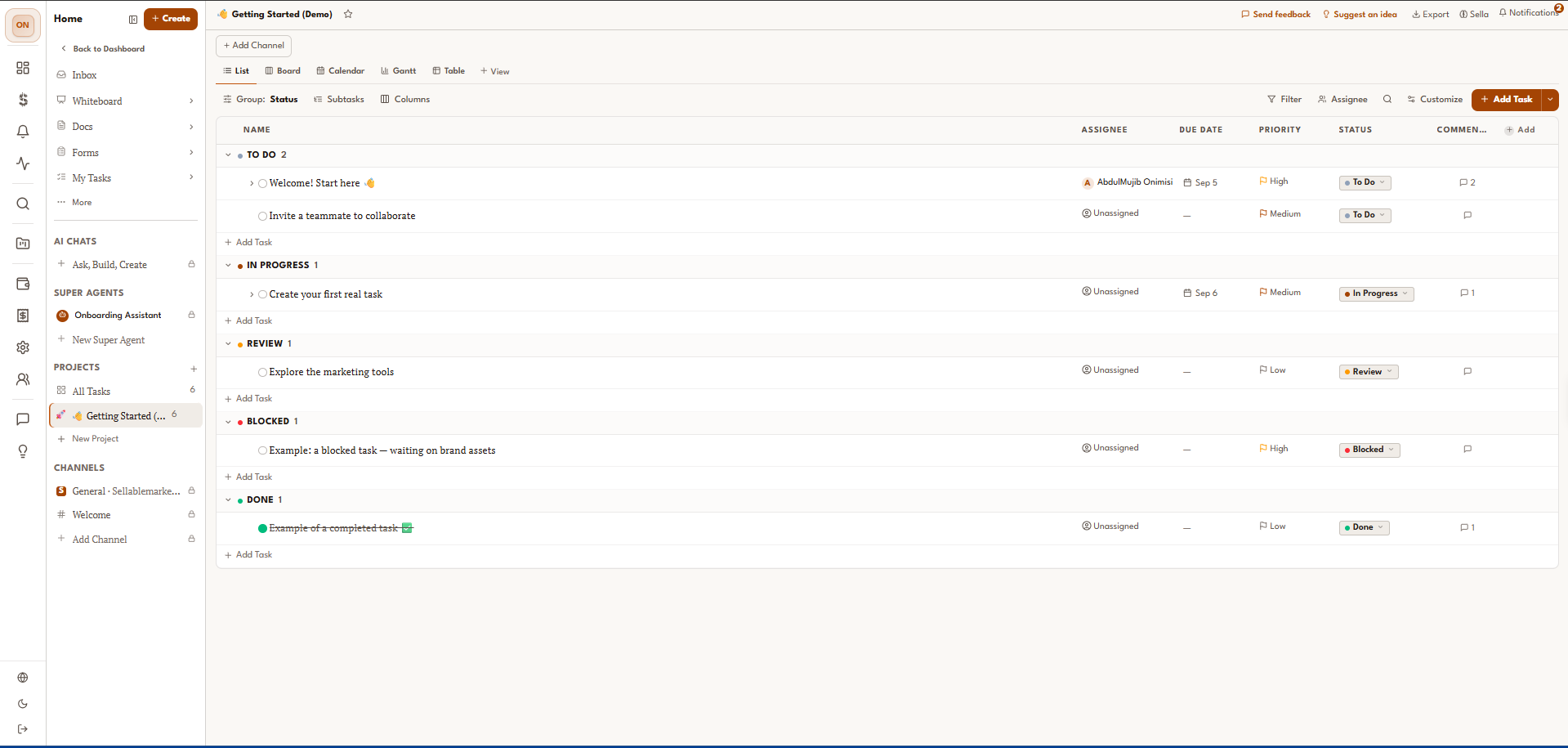
A finding is not work. Competitor Gap tells you there are nine pages you should have written. Then what? For most teams, the answer is a screenshot pasted into a group chat, and three of the nine are never written.
Sellable Workspace has Projects and Tasks built in, so a finding becomes an assigned piece of work with an owner and a date. Sella, the assistant, has read every run in the workspace and drafts the plan from your own numbers rather than from assumptions about your market. It proposes. It never executes. Nothing is created until you approve it.
That sounds like a small thing. It is not. Research is the cheap part. Content programmes almost never stall from a shortage of insight. They stall because the insight was never assigned to anybody.
What This Means for You
The tool you need depends on the shape of your work, not on which brand markets itself best. If your income is lumpy, and you would rather not pay in a month when you have no income, credits are the better option. That is the case for Sellable Workspace, and it rests on how you get paid rather than on a feature nobody else has.
What is not optional in 2026 is measuring both fronts. Google rankings and AI visibility are the same underlying work showing up in two places, and only one of them appears in your analytics.
Start by measuring one thing properly. Pick your main service term. Find out what it actually does. Decide from there.
Run your first scan free. 25 credits, no card required.
Work or own a business in Abuja?
We keep a page for businesses here. Local pricing, promotions and discounts, business events, updates on anything that could affect how you operate, and search data measured across Abuja districts.
Frequently asked questions
What are the best SEO tools for marketing in 2026?
The best SEO tools for marketing cover six jobs: keyword discovery, content clustering, competitor gap analysis, technical site auditing, content briefing and optimisation, and AI visibility tracking. Sellable Workspace covers all six jobs on a pay-as-you-go credit model, with AI visibility included rather than sold as an add-on, and publishes directly to a connected website.
What is Sellable Workspace?
Sellable Workspace is a pay-as-you-go SEO research platform built by Sellable Marketing, a digital growth agency operating across the UK, United States, Europe and Nigeria. It includes Keyword Finder, Keyword Snapshot, Content Clusters, Competitor Gap, Site and SEO Audit, Topic Finder, SEO Brief Generator, Content Optimizer, Repurpose Content, My Content, AI Visibility, and built-in Projects and Tasks. You buy credits instead of a monthly seat; the credits never expire, and a month in which you run nothing costs nothing. New accounts start with 25 free credits and no card.
Are free SEO tools good enough for marketing?
Free SEO tools are adequate for validating a single keyword and inadequate for planning a content programme. Most return a volume bracket such as "100 to 1K" rather than an exact figure, which covers terms worth ignoring and terms worth a quarter of the work without distinguishing between them. Free tiers also cap daily lookups, offer no competitor gap analysis, and do not measure whether AI assistants mention your business. For SEO tools for small businesses in particular, the cost of a strategy built on an unmeasured term is usually far higher than the cost of the tool.
What are AI SEO tools, and which kind actually matters?
AI SEO tools are split into two groups. The first generates content: drafts, headlines, meta descriptions. The second measures AI visibility, which is whether your business is named when someone asks ChatGPT, Claude, Gemini, Perplexity, or Copilot to recommend a provider in your industry. The second group changes decisions. Unlike Google, an assistant answer has no ranked positions and no ten links. You are either in the sentence, or the answer is about a competitor, and that traffic does not appear as organic search in analytics. Most major platforms sell AI visibility as an add-on or a higher tier. Sellable Workspace includes it alongside keyword data in the same workspace.
Which SEO tools for agencies suit irregular income?
Pay-as-you-go tools suit irregular income better than monthly subscriptions. Agency and freelance work is typically lumpy: two strong months, a quiet one, then a delivery sprint. A monthly seat charges the same in the month you win nothing as in the month you win three clients. Credit-based SEO tools for agencies reverse that shape. You top up when you close work, credits never expire, and a quiet month costs nothing. For agencies earning in naira, this also removes exposure to monthly dollar billing and exchange rate movement.
Ask Sella anything about this article
NewGet personalised, AI-powered answers built on our team's trusted growth frameworks.
Ask anything about "The Best SEO Tools for Marketing in 2026: What Actually Works", or pick a quick action:
Tip: highlight any passage in the article to ask AI about that specific section.